Tuesday, October 27, 2015

Rattlesnake Bite

Country music star Kevin Fowler has shared gruesome pictures of a friend's snakebite injuries. In one photo, a huge, grey blister has formed that almost covers the man's entire palm and half of his fingers. A second picture shows the bloody aftermath of the blister being popped, with pus oozing out of the wound.

Rattlesnake bites aren't fatal if treated quickly and effectively but they can cause nasty injuries. An estimated 7-8,000 people are bitten by venomous snakes every year in the USA, with about five deaths occurring each year. If an antidote is given within two hours of the bite, there's a 99% chance of survival - most deaths occur between six and 48 hours of the bite.


Other snakebite posts here, here and here

Saturday, October 17, 2015

Haitian Voodoo Rites

Voodoo is one of the most misunderstood religions. Rituals involving animal sacrifices and its associations with skeletons and possession have given it a sinister reputation.  But New York photographer Les Stone sees it as a fascinating practice. He has been photographing Voodoo followers in Haiti for 25 years and produced incredibly powerful images from over 200 visits.He describes voodoo as 'a huge package of physical sensory overload' and his pictures  - of bulls and goats being bled to death, followers bathing in mud pools and blood-soaked dresses - capture the intoxicating energy of the ceremonies he attended. 

These men, photographed in a commune called Jacmel in southern Haiti, are portraying chaloskas, described by Stone as 'characters in military garb with a protruding mouth and claw-like teeth'. This figure is based on a military officer, Charles Oscar Etienne, who terrorised Jacmel around 1900

The blood of a slaughtered goat has stained the bandanna and clothing of a dancer at the Souvenance carnival of Haitian Voodoo

A worshipper carries a sword in Souvenance during an Easter ceremony where Voodoo rites inherited from their ancestors are celebrated

The Houngan stares into the camera as he licks the blood of a sacrificed animal from his fingers in St Yves

On a street in Port au Prince, during the Day of the Dead a man walks among the crowds with a skull on his head

A woman dressed in blue holds a carton of water in her hand as she lights candles on a cross as a symbol of respect to the spirits

At Plain Du Nord, a Voodoo society holds swords and liquor as they prepare to dance to celebrate and welcome spirits

Goat's blood runs down a woman's face after a sacrifice

A woman holds a candle while in a trance in Plaine Du Nord, Haiti

In St Yves, a Veve (a religious symbol commonly used in Voodoo) is created with flour on the ground preceding a ceremony

In the Plain Du Nord a woman smokes a cigar during the Voodoo ceremony which takes place in and out of the sacred 'mud pool'

A sacrificed goat lies beside a sacred mud pool in Plaine Du Nord as a man stares up at crowds gathered as part of the ceremony

A woman covered in the blood of sacrificed animals is pictured in the throes of her possession by the spirits at a ceremony in Sucre

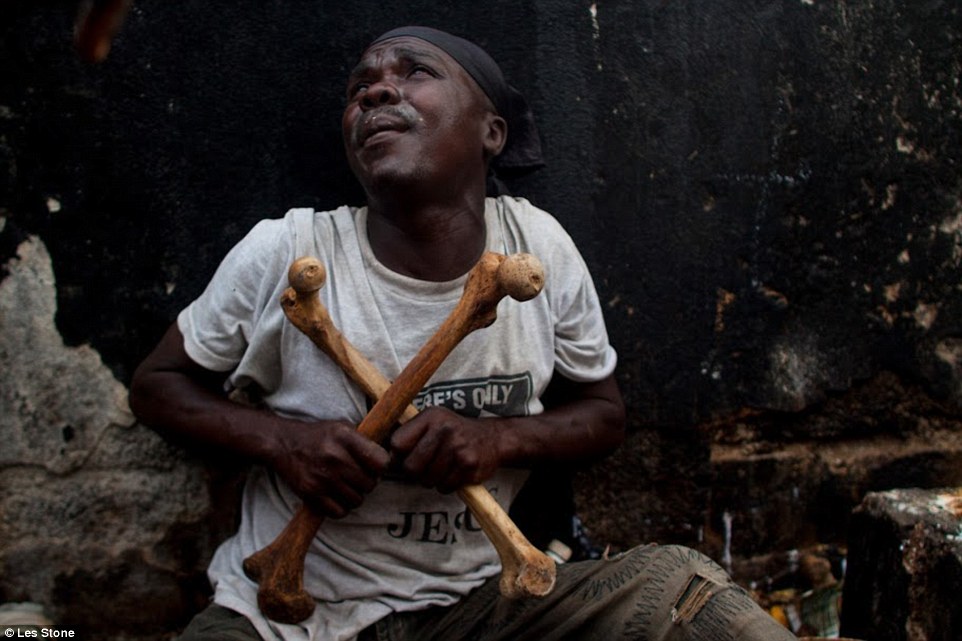
This scene was found by photographer Les Stone in the central cemetery of Port Au Prince during Ghede - the day of the dead

A man sits clutching bones at the Port au Prince cemetery during Ghede, the day of the dead celebrations in Haiti

Symbols of respect for spirits are strapped to tombstones by Haitian people during the Voodoo ceremonies every year


All photos credit: Les Stone

Wednesday, October 7, 2015

Doctor Claims to Have Discovered how to Perfectly Preserve the Dead

A doctor claims to have discovered how to perfectly preserve dead bodies – after unveiling the corpse of his own brother. Dr Edgar Aranda tested his embalming technique on his sibling Ramon who died 13 months ago. Video shows the Peruvian doctor disinterring his brother and unwrapping the corpse in front of stunned relatives in a bid to prove his experiment. Close-up shots of Ramon's hand and forearm reveal his skin to be remarkably similar to when he was alive. The doctor, who is also a university lecturer, has spent 10 years developing the special formula with the help of his students. 


Monday, September 28, 2015

The Largest Cremation Site in Varanasi

On the western bank of the Ganges in the ancient city of Varanasi, the fires of the Manikarnika Ghats have been burning for thousands of years. This holy city, in Uttar Pradesh, India, is the most sacred place on earth for Hindus and it is believed that if a person’s ashes are scattered here then their soul will finally achieve nirvana (moksha). But to liberate the soul, the worn-out body must first be burned. A series of stunning and rare images, captured by photographer Michal Huniewicz, give a remarkable insight into the last hours of the Hindu body at Manikarnika Ghats - the largest cremation site in Varanasi.

  Up to 300 people a day are cremated at this ‘burning ghat’, named for the steps that lead down to a body of holy water.For centuries, the old and sick have flocked to the site to die here on the banks of the Ganges, and special buildings on the site are reserved for those awaiting their final hours. But the atmosphere at the giant funeral site is not one of sorrow, as mourners instead laugh, chat and play cards as the funeral preparations are carried out.The Hindu attitude to death is not one of loss, but instead follows the idea of ‘shedding’ the worn-out body, as one might throw away clothes that are too worn-out to wear.


The Manikarnika Ghat fires in Varanasi is the most sacred place for Hindus to be cremated. Here, piles of wood are stacked for burning, cows and goats can be seen alongside male family members and spectators observing the cremations from boats on the river

A shrouded body is taken into the Ganges to be washed and prepared ready for cremation at the Manikarnika Ghats, where Hindus have been cremated to have their souls liberated from their bodies for thousands of years

Two tourists, who are encouraged to witness the ritual, sit in a boat on the Ganges in front of a large heap of hot human ashes in the background.

Death is believed to be contagious and it is only Doms, a subcaste of the Untouchables, that is allowed to touch dead bodies

Piles of mango wood logs, which are cheaper than sandalwood, are used for burning human bodies.

A body is taken down to the Ganges on a bier, wrapped in an orange shroud. It should be burnt in 24 hours of death

The body is taken down to be immersed in the river by family members on a bamboo bier. The man in white is the closest male relative to the deceased, who is tasked with carrying out the funerary rites. The only women that tend to be present are foreign tourists

The body is briefly immersed in water before being carried back up the stairs before the cremation begins

The bodies are left on the stairs for about two hours so they can dry before the cremation takes place nearby

When the body, which may have been left alone, is sufficiently dry it is taken by the family members to the burning pit

The bodies are left on the stairs, or ghats, for hours. Young boys, most probably relatives of the deceased, sit and wait

The Doms charge for the cremation itself, but also take a cut from the expensive wood sold near the ghats

The pits are located on four different levels, one for each caste. Those pictured are from the Kshatriya (warrior) caste

The body is freed from the rope and ready to be placed on the pyre and covered with the wood the family has bought

A typical funeral pyre requires 300 kilograms of wood to burn the body sufficiently.

Wealthier families may choose to use the much more expensive sandalwood instead of the cheaper mango wood, while the poorest may just use cow dung, and some simply throw the body directly into the river

Clarified (and edible) butter called ghee smeared on the wood. In the old days, ghee was also used to fill the body before burning

Sandalwood powder is poured over to cancel out the smell of burning hair. Surprisingly, this does not smell unpleasant

A relative scatters some sort of incense, possibly black musk from Nepal, over the remains before the wood is lit

The man lighting the pyre is likely to be the eldest son or closest male relative. He shaves his head and wears white out of respect

A cloud of smoke is released from the pyre. The Dom sits beside the cremation site to make sure the fire keeps burning

A dog lying at the ancient site is covered in ash from the fires of the Manikarnika Ghats

Heavy wood on top of the body is important as heat causes muscles to contract which could cause the body to sit up

Bamboo sticks are used to ensure the body is broken down in the fire as part of the Hindu practice of burning ghats

Cremation is preferred among Hindus as fire is believed to purify so the individual's spiritual essence can be freed from the body

Joss sticks and various incense are used at the site to avoid the place smelling of the hundreds of bodies cremated every day

An aerial photograph shows the fires burning at the Manikarnika Ghats on the banks of the Ganges from above


All photos credit: Michal Huniewicz
Via the Daily Mail