The Cranium, also called the "Skull," describes the skeleton of the head, face and mandible. The skull is one of the principle groups of bones in the human anatomy.
The skull consists of twenty-six bones: eight bones form the cranium,
which houses the brain and ear ossicles, plus fourteen facial bones,
which form the front of the face, jaw, nose, orbits, and the roof of the
mouth, three more bones make up the inner ear ossicles, and one more,
the hyoid bone, is in the neck and is attached to the temporal bone by
ligaments and anchors the tongue. The mandible is the only movable part of the skull, forming the lower
jaw and holding the teeth. Joints known as sutures hold the bones together. At birth, the bones are
not fully fused together, making the skull flexible. As a person grows,
the bones of the cranium are fully fused together.
The human body can take a remarkable amount of punishment, given
bones made of one of the strongest materials found in nature. So how much does it take to crack a bone? Bone is extraordinarily strong — ounce for ounce, bone is stronger
than steel, since a bar of steel of comparable size would weigh four or
five times as much. A cubic inch of bone can in principle bear a load
of 19,000 lbs. (8,626 kg) or more — roughly the weight of five standard
pickup trucks — making it about four times as strong as concrete. Still, whether or not bone actually withstands such loads depends heavily on how quickly force is delivered.
 |
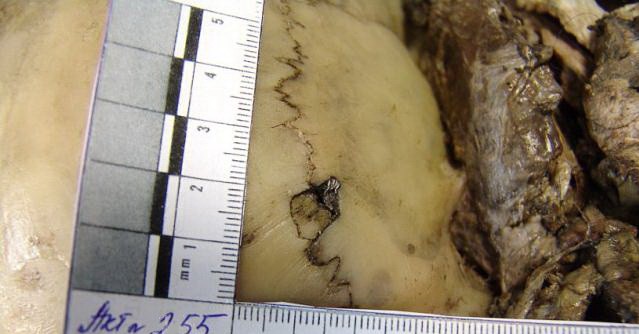
| Injury output for triggering PAF oblique skull. |
 |
| Graze wound of the head with identifiable tiny skin tags (pointing left) and an abrasion at the left end of the wound. The bullet traveled left to right. |
 |
| Depressed skull fracture — In the depressed fracture cracks were found remnants of a plastic bag |
 |
| Axe blows to the head. At autopsy revealed six lacerations, bruised parietal and occipital regions and three depressed fracture of the cranial vault. |
 |
| Skull fracture gunshot |
 |
| Skull fracture |
 |
| Impact sites of lead pellets on the inner table of a skull due to a shotgun wound to the head. |
 |
| Injury output projectile from a firearm in the skull. |
 |
| Hole in the skull |
 |
| Skull fracture from shovel handle beating |
 |
| Bullet hole in the skull |
 |
| Axe blows to the head. At autopsy revealed six lacerations, bruised
parietal and occipital regions and three depressed fracture of the
cranial vault. |
 |
| Axe blows to the head. At autopsy revealed six lacerations, bruised parietal and occipital regions and three depressed fracture of the cranial vault. |
 |
| Injury-piercing blunt impact projectile from a firearm on the inner surface of the frontal region. |
 |
| Fractures reveals once the scalp of the deceased has been pulled back during autopsy |
 |
| Comminuted skull fracture with brain content output. |
 |
| Injury to the skull by PAF firing obliquely in the skull. |
 |
| Injury oblique shot of PAF in the skull. |




.jpg)


